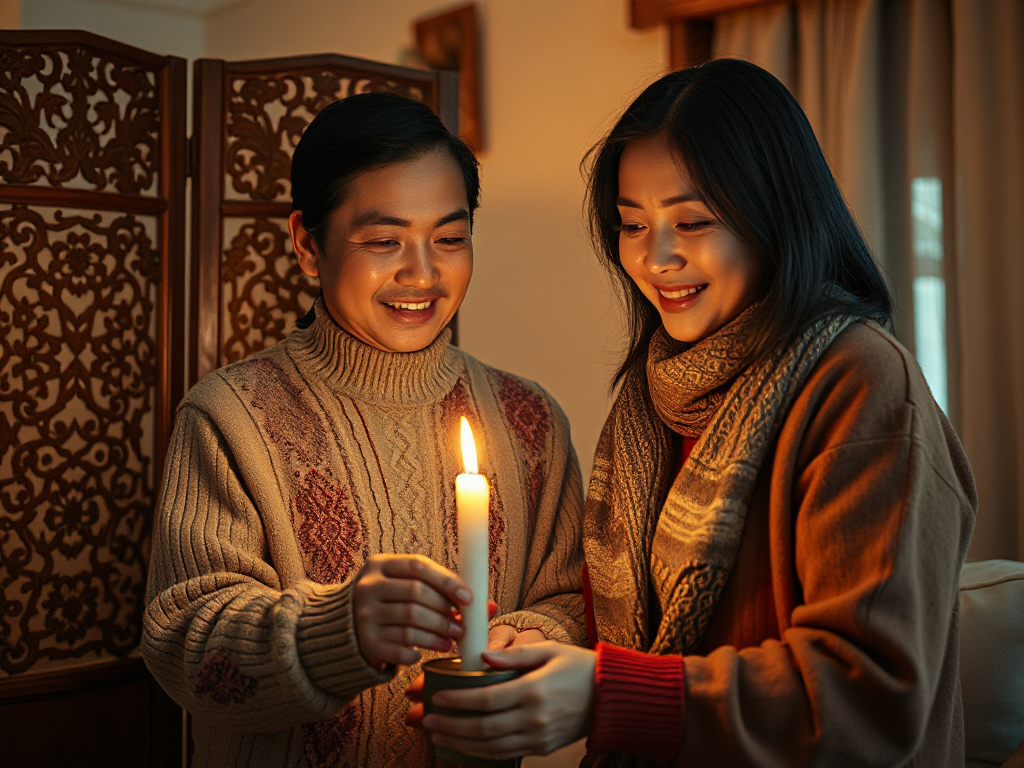
"Two people meet at a border that no map drew — and decide to live there, fluent in two languages of meaning, native to neither."
Defining the form
An interfaith or intercultural marriage is a union between two people who were formed by different answers to the questions that traditions exist to answer: what is sacred, what is owed to ancestors, how a child becomes who they are, what a good death looks like, what a wedding must contain to count. The difference can be religious — a Catholic and a Jew, a Muslim and a Hindu, a believer and a secular humanist. It can be cultural — partners whose families carry different scripts for hospitality, money, obligation, and shame. It can be linguistic, or one of social class, the quietest and often most stubborn divide of all. What unites these marriages is not the size of the gap but its location: it runs through the deepest layer, the one usually inherited rather than chosen, and rarely examined until two lives are pressed against it.
This form is not defined by conflict. Plenty of same-faith couples fight more than interfaith ones. It is defined by translation — by the daily, often invisible labor of rendering one inherited world legible to another, and of building a third world the two of you can actually live in.
Why it is increasingly common
For most of human history, marriage was endogamous by design: you married inside your faith, your village, your caste, your class, because those were the only people you ever met as marriageable. That world is dissolving. Urbanization mixes populations that were once kept apart. Universities and workplaces throw together people from every tradition at exactly the age they fall in love. Migration scatters communities and reassembles them as neighbors. Declining religious affiliation in much of the West means fewer people treat shared doctrine as a precondition. And dating now happens on platforms indifferent to the boundaries families once policed. The result is structural: the pool of potential partners has been pried open, and difference has moved from the exception to the baseline. What once required rebellion now often requires only proximity.
The flashpoints: weddings, children, death
Interfaith and intercultural difference tends to lie dormant until it meets a threshold — and three thresholds reliably wake it. The wedding comes first: whose officiant, whose rituals, whose God is named aloud, which family’s expectations are honored and which are quietly disappointed. Long before the marriage begins, the ceremony forces a negotiation about whose world gets to host. Children come second, and harder: in what faith, if any, are they raised; whose holidays anchor the year; which language they dream in; whose grandparents feel like strangers. A couple can defer this question for years, but a child collapses the deferral. Death comes last and deepest — how a parent is buried, whether a body is cremated or interred, what prayers are permitted, how grief is allowed to be expressed. These are the moments when “we love each other” meets “but this is how my people do it,” and the marriage discovers what it is actually made of.
Pew Research Center found that 39% of Americans who married since 2010 have a spouse of a different religious group, up from 19% among those who married before 1960 — evidence that interfaith marriage has shifted from rare exception toward statistical norm in a single lifetime. Source: Pew Research Center, “Religion in Marriages and Families.”
Strategies that work
The couples who thrive at this crossing tend not to be the ones who pretend the difference is small. They are the ones who name it early, in detail, before a wedding or a pregnancy makes the conversation urgent and tense. Relationship researchers John Gottman and, separately, Scott Stanley and Howard Markman have shown that long-term success depends less on sharing values than on aligning around shared meaning and handling difference without contempt — a finding that maps almost exactly onto what interfaith couples face. The durable strategies are concrete: deciding in advance what each partner will keep, what each will adopt, and what the two will build new; attending one another’s services and rituals not as tourists but as participants; learning enough of the other tradition to honor it without converting to it; and treating the marriage itself as the third culture, neither his nor hers, with its own emerging customs. Curiosity, it turns out, is more protective than agreement.
When families resist
Often the sharpest opposition comes not from the partners but from the people who raised them. A parent who fears the loss of a lineage, a tradition, a grandchild’s faith, is not always being cruel; they are grieving a future they had assumed. That grief can still do damage — through ultimatums, withdrawal, conditional welcome, or the slow erosion of contempt disguised as concern. Couples navigating this learn to distinguish a boundary from a betrayal: they can decline an ultimatum without declaring war, hold their union firmly while leaving the door open, and refuse to let a disapproving relative become a third party inside the marriage. Some families come around when a grandchild arrives or when the union simply outlasts the prophecy of its failure. Some never do, and the couple builds a chosen circle of welcome elsewhere. Either way, the work is to protect the partnership from becoming a referendum on everyone’s heritage.
When the couple is also queer
The three flashpoints — the wedding, the children, the death — assume a couple both traditions can at least picture. For a queer interfaith couple, each one is doubled. The question is not only whose officiant but whether either tradition will marry them at all; not only in which faith a child is raised but whether two mothers or two fathers are acknowledged as parents within it; not only whose rites govern a funeral but whether a surviving spouse will be named as a spouse at the grave. Traditions diverge sharply here — some communities bless same-sex unions outright (Reform Judaism, the Episcopal Church, the United Church of Christ and others), while many do not — so the couple navigates not one map of acceptance but two, often misaligned. The translation this entry describes runs through an extra layer no inherited script prepared.
And yet this is also where the entry’s central skill is most practised. Long before “third culture” became advice for interfaith couples, queer people were building exactly that out of necessity — inventing chosen family, chosen ritual and chosen kinship when the given ones withheld their blessing. A couple who has already had to author its own ceremonies, name its own kin, and hold a bond the wider world hesitated to recognise arrives at the interfaith crossing not as a more fragile case but as a more fluent one. What this entry recommends to everyone — build the marriage as its own emerging culture, neither his nor hers — queer couples have often been doing all along.
Why it belongs in a modern atlas
Interfaith and intercultural marriage deserves its own entry because it is no longer a special case — it is the direction the whole institution is moving. To treat it as an exotic difficulty is to misread the century. These marriages are laboratories for a skill the entire species now needs: the capacity to love across the very lines that elsewhere produce suspicion and war. A couple who can raise a child between two faiths, bury a parent across two rites, and still wake up devoted to each other has demonstrated something about human possibility that reaches far past their own front door. An atlas of relationship forms that left this out would be describing a world that no longer exists.
How Partnersin.love holds it
This one lives in Orbit.
Orbit is the inclusive centre that holds difference without flattening it — and the interfaith couple lives at the very crossroads of difference, every day.
Enter OrbitThreads to
The spiritual dimension of this crossing is explored in Faith and Love, and the broader craft of bridging it in Love Across Difference. Its closest cousin in the Atlas is Arranged Marriage, where family and tradition shape the union from the start. For the deeper agreement that lets two worlds become one home, see The Covenant.