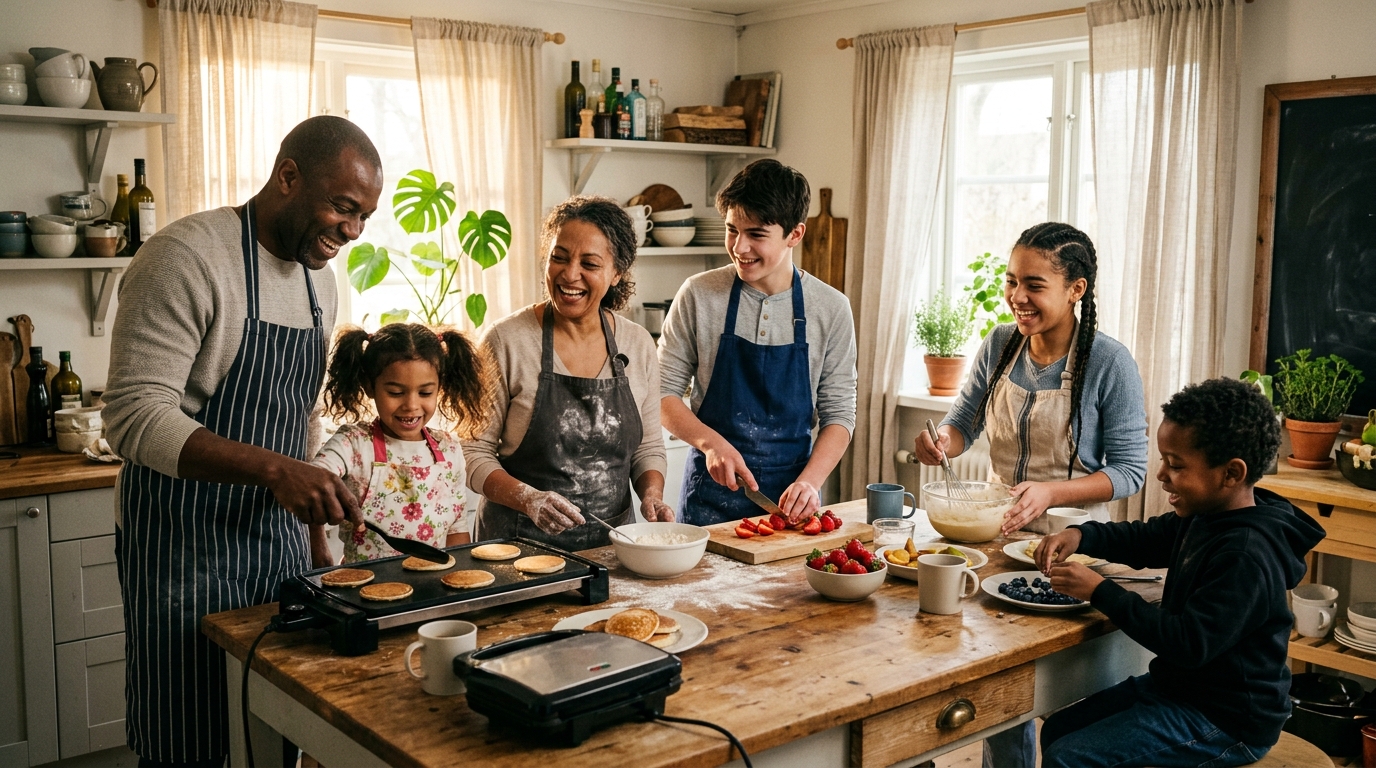
"A blended family is not two halves made whole — it is several whole lives, learning to share one roof, one table, one future."
What it is
A blended family — sometimes called a stepfamily or a reconstituted family — is a household formed when at least one partner brings a child from a previous relationship into a new union. The configurations are endless: a parent and their children joining a childless partner; two single parents merging their broods; a couple who add an “ours” child to a houseful of “his” and “hers.” What they share is a defining feature: the family did not begin together. It is assembled from pieces that already had a shape, a rhythm, a history of their own.
This is not a fringe arrangement. In much of the world it is now a default outcome of a society where divorce, separation, and serial partnership are ordinary. The blended family is, in many places, simply what a family becomes after a first one ends.
Why “blended” is harder than “nuclear”
The word blended is gently optimistic — it suggests a smoothie, everything folding effortlessly into one. The reality is closer to a transplant: tissue from one body introduced into another, where the immune system has every reason to resist. A nuclear family grows its bonds slowly, from the inside out, beginning with infants who know no other home. A blended family must form its bonds laterally, between people who arrive as near-strangers, each already loyal to someone else.
Researcher Patricia Papernow, who has spent decades studying these households, describes the stepfamily as carrying “structural challenges” that no amount of love can wish away: built-in insider-outsider dynamics, loyalty conflicts, a parent caught between a child and a partner, and the long shadow of an absent former partner. These are not signs of failure. They are the architecture of the form itself.
Roughly one in six children in the United States lives in a blended household — a home with a stepparent, stepsibling, or half-sibling. Step- and blended families are among the most common family structures in the country, yet remain among the least supported by law, language, and culture. Source: Pew Research Center analysis of U.S. Census data.
The stepparent’s impossible role
No role in family life is as ill-defined as the stepparent’s. You are asked to care for children who did not choose you, to enforce rules you did not set, to love deeply while claiming no authority, and to accept — often — that your effort will be met with suspicion or grief. The culture offers no script. A stepparent is too involved to be a guest and too provisional to be a parent. The fairy tales make it worse: the very word stepmother arrives pre-loaded with menace.
Papernow’s research is blunt about the central error new stepparents make: moving too fast. The stepparent who tries to discipline, to bond, to “become a real parent” within months almost always meets a wall. Connection in a blended family is earned slowly, at the child’s pace, in the small reliable acts of showing up — not seized by decree.
The word remembers a loss
The menace in stepmother is older and stranger than the fairy tales. The prefix step- has nothing to do with steps, or with standing one remove away; it descends from the Old English stēop-, from a Germanic root meaning bereaved. A stēopcild was an orphan — a child deprived of a parent by death — and a stēopmōdor was, quite literally, the woman who became mother to an orphaned child. For twelve centuries the word has carried the very truth this entry keeps returning to: every blended family begins in a loss the children did not choose. The language remembered it long after the culture stopped listening.
Some languages are now trying to forget it on purpose. Swedish has largely retired styvbarn — its own cognate of “stepchild,” sprung from the same root for bereft — in favour of bonusbarn, a “bonus child,” and bonusförälder, a “bonus parent”: the partner’s children reframed as unexpected gain rather than inherited grief. It is a warmer word, and it has spread. But the relabelling has its skeptics, and this entry’s own counsel is the reason — a child in the disoriented early years of a blended home may not feel she has been handed a bonus, and asking her to perform gratitude for a life she would never have chosen can quietly deny the loss that step- at least had the honesty to name. The steadiest families seem to hold both words at once — the gift and the grief — and let the child decide, in her own time, which one fits.
Loyalty binds and the absent parent
A child in a blended family lives inside a loyalty bind. To warm to a stepparent can feel like a betrayal of the parent who is no longer in the house — even when that parent encourages it, even when the child longs for affection. Liking the new adult can feel like disloyalty to the old love. This is not manipulation; it is the impossible math of a young heart trying to honor everyone at once.
The absent parent — present in alternate weekends, in a different home, or only in memory and photographs — remains a member of the household in spirit. Their preferences, their grievances, their version of events travel back and forth with the child. A blended family that treats the former partner as an enemy forces the child to choose sides; one that treats them as a co-parent, however imperfect, gives the child permission to love freely in both homes.
What helps a blended family thrive
The research points the same direction with surprising consistency. Let the biological parent stay the primary disciplinarian, at least at first, while the stepparent builds warmth without wielding authority. Protect the couple bond — the partnership is the load-bearing wall, and children, paradoxically, feel safest when it is strong. Go slow; expect bonding to take years, not months, and measure success in patience rather than in milestones. Make space for grief, because every blended family is built on a loss the children did not choose. And keep the doors between households as open and low-conflict as the adults can manage.
Papernow frames the whole journey as a stepfamily cycle — predictable stages that move from early fantasy and confusion, through a hard middle of restructuring, toward a settled, genuinely intimate later phase. Families that understand the map suffer less, because they stop reading normal difficulty as proof that they have failed.
Why it belongs in a modern atlas
The blended family is one of the most common households in the modern world and one of the least honestly described. Culture still measures it against a nuclear ideal it can never replicate, and then calls the difference dysfunction. This atlas refuses that frame. A blended family is not a broken first family limping along — it is a distinct form with its own demands, its own slow rewards, and its own quiet heroism. To name it accurately is to give the millions living inside it permission to stop apologizing for needing more time, more intention, and more grace than a family that began as one.
How Partnersin.love holds it
This one lives in Anchor.
Anchor is the world of the household built to last — and the blended family is that household assembled from more than one past, requiring more intention than any other.
Enter AnchorThreads to
It usually begins with a Second Marriage — the union that builds the blended household in the first place. The work of raising children across two homes is mapped in Parenting Models. The art of ending the first relationship well, so the blended one can breathe, lives in Conscious Uncoupling. And the everyday structure of sharing one roof without a single origin story is closest to Cohabitation.