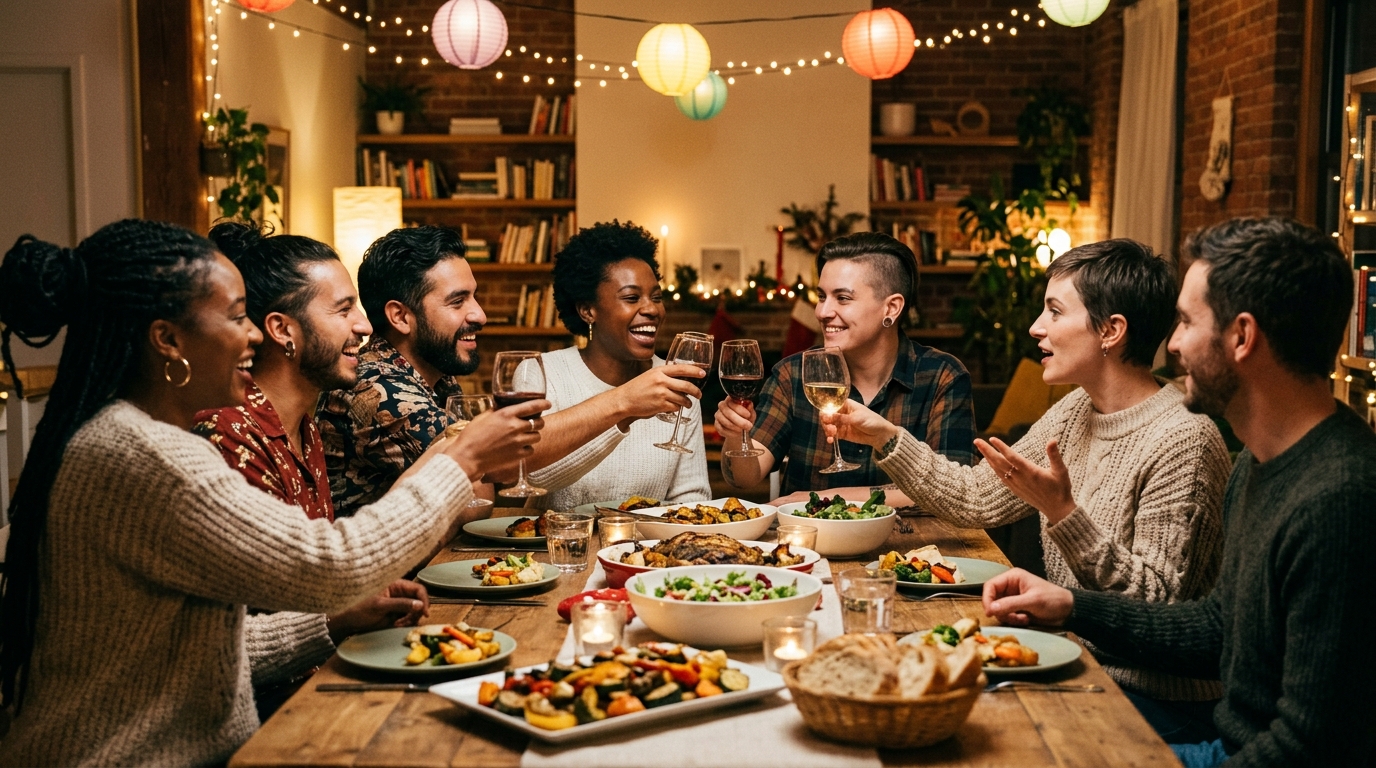
"Family is not who you are related to. Family is who shows up."
What a chosen family is (and is not)
A chosen family is not a lifestyle brand or a warm metaphor for a tight friend group. It is a social structure with real emotional stakes — one in which people explicitly or implicitly take on the obligations that culture normally assigns to blood relatives: being there in the hospital, showing up for the hard phone call at midnight, remembering the birthday that nobody else remembers, taking responsibility when things go wrong.
The distinction from an ordinary friend group is not about affection but about intensity, commitment, longevity, and mutual obligation. You might love your book club dearly without expecting them to co-sign a lease or sit with you through chemotherapy. A chosen family member might. Sociologist Judith Stacey has argued that chosen family represents one of the most significant expansions of kinship in the modern democratic era — not a departure from family values, but an extension of what family has always been at its best: a structure of care and belonging that holds people through time.
The practical markers are recognizable: shared holiday rituals, named emergency contacts, informal financial solidarity, decisions made together that most people reserve for spouses or parents. The emotional marker is simpler — these are the people you call first.
The history and roots
Chosen family is ancient, though the term is recent. Immigrant communities have long reconstructed kinship networks in new countries, turning neighbors and compatriots into uncles and aunts in all but legal name. Religious communities — monastic orders, intentional congregations, intentional settlements — have practiced chosen kin for centuries under different vocabularies. Mutual aid networks, particularly among African American communities under conditions that systematically destroyed legal family ties, built robust chosen kin structures that carried people across generations.
The most documented and culturally visible origin story, however, belongs to the LGBTQ+ community — and specifically to Black and Latino queer youth in New York City in the 1970s and 1980s. Anthropologist Kath Weston, in her landmark 1991 study Families We Choose: Lesbians, Gays, Kinship, traced the emergence of chosen family as a deliberate social form among gay and lesbian people who had been rejected — or feared rejection — by their families of origin. When the biological family becomes unsafe or unavailable, people build the family they need.
Jennie Livingston’s 1990 documentary Paris Is Burning brought the ball community’s “houses” to wide attention — chosen families with literal names (House of Xtravaganza, House of LaBeija), hierarchies of mothers and children, and fierce mutual loyalty. These houses were not metaphor. They provided housing, mentorship, income, protection, and grief when members died from AIDS. They were survival structures.
Most of the world formalized it
There is a quiet assumption beneath the phrase “no legal standing” — that chosen kinship is naturally informal, a workaround the law simply hasn’t gotten around to recognising. The cross-cultural record says otherwise. In much of the world, kinship you make rather than inherit has been formal, named, and binding for centuries. Across Catholic Latin America and southern Europe, compadrazgo turns a child’s parents and its godparents into compadres — co-parents bound by lifelong, often cross-class obligations that the anthropologists Sidney Mintz and Eric Wolf documented as a load-bearing institution, not a sentiment. In Islamic law, milk kinship (raḍāʿ) holds that a woman who breastfeeds an infant becomes its kin — so much so that milk-siblings are forbidden to marry, a made bond with consequences enforceable in court.
Seen against that backdrop, the reframe sharpens: chosen family is not a modern invention, nor a specifically queer or Western one. It is closer to a human universal that the modern, individualist West happens to have stripped of formal recognition — leaving its people to rebuild, with power-of-attorney forms and Friendsgivings, what other societies kept as law and rite. The ball houses, and the friend who co-signs a lease, aren’t improvising something unprecedented. They are reaching back toward something the West misplaced.
Who builds chosen families
The original context was LGBTQ+ survival, but chosen family has spread far beyond it. Today, the people most likely to build chosen families include: adults estranged from abusive or absent families of origin; adults who are geographically far from their biological relatives; childfree adults whose families do not understand or affirm that choice; people whose families of origin are alive but emotionally unavailable; immigrants and expatriates rebuilding social networks from scratch; and — increasingly — people who simply prefer it. Chosen family is no longer only a fallback. For a growing number of people, it is the first choice.
The demographic is also aging. Older adults who are single, widowed, or childless are building chosen family networks explicitly to provide the care and companionship that marriage and parenthood once guaranteed. The question “who will be there for me?” is being answered, deliberately and collectively, by people who decided to answer it together.
How they actually work
Chosen families function through negotiation — explicit or implicit — of roles, expectations, and presence. Some groups formalize this through chosen family agreements: written or spoken understandings about what each person commits to. Who is the emergency contact? Who holds the spare key? Whose name is on the medical directive? Who shows up for the surgery, the move, the grief?
Holiday rituals matter enormously. The Friendsgiving, the chosen family Passover, the group vacation that happens every year without fail — these are not decorative. They are the ceremonies that mark belonging and reproduce it across time, the same way that family dinners and reunions mark blood kin. Shared grief also binds: attending each other’s losses, honoring each other’s dead, holding the weight of loss together.
Financial solidarity is common and underacknowledged — informal loans, shared subscriptions, the friend who covers rent in a crisis, the group that collectively covers a funeral expense. None of this appears in legal documents. All of it is real.
The legal and practical gaps
Chosen family has no automatic legal standing. A person’s chosen family member has no inherent right to hospital visitation, no place in intestacy law if there is no will, no authority to make medical decisions without an advance directive, no recognition in immigration applications, no entitlement to bereavement leave under most employment contracts. The law’s family is still the biological and legal family — spouses, parents, children, siblings — and chosen family falls outside that frame entirely.
What people actually do to fill this gap: they draft powers of attorney, healthcare proxies, and advance directives that name chosen family members explicitly. They write wills. They designate beneficiaries on retirement accounts and life insurance policies. Some consult lawyers who specialize in non-traditional family structures to ensure their chosen relationships are legally documented. None of this is simple or cheap, and none of it is automatic. It requires intention — which is, perhaps, appropriate. Chosen family is, by definition, the family you make on purpose.
Advocacy organizations including the National LGBTQ Task Force have pushed for legal reforms that would extend some protections to chosen kin, including expanded hospital visitation policies and broader definitions of “family” in leave laws. Progress has been uneven.
Why it belongs in a modern atlas
Chosen family is one of the fastest-growing relationship forms in the United States and much of the industrialized world. It is also one of the most under-named — lived by millions of people who may not have a word for what they have built, who are told implicitly that what they have is not quite real family, not quite serious, not quite permanent enough to count. This atlas disagrees. A bond is real because of what it does and what it costs — not because of what it is called, or which office issued a certificate to confirm it.
Naming this form matters because unnamed things are harder to protect, harder to defend, harder to grieve when they change. When your chosen family member dies and your employer does not offer bereavement leave for “friends,” you have lost someone real without the language or the rights to say so. This is an injustice. And it begins with the failure to name.
The NORC General Social Survey has found that roughly one in five Americans reports having a close chosen family — a group of non-biological, non-legal kin they consider primary family. The number is higher among LGBTQ+ adults, young adults, and those estranged from families of origin. Source: NORC/GSS; National LGBTQ Task Force.
How Partnersin.love holds it
This one lives in Wayfarer.
Chosen Family lives in Wayfarer — the world for bonds that travel outside the default map, defined by depth and choice rather than by the categories society hands you.
Enter WayfarerThreads to
Its closest tool is The Kinship Map — built specifically to hold chosen bonds. The solo or aromantic person who lives inside a chosen family is at home in Aromantic. The philosophy behind it is the The Tyranny of the Couple — a critique of a culture that counts only romance. The loneliness that often precedes it is covered in The Loneliness Epidemic, and the art of building adult friendship in The Underrated Love.