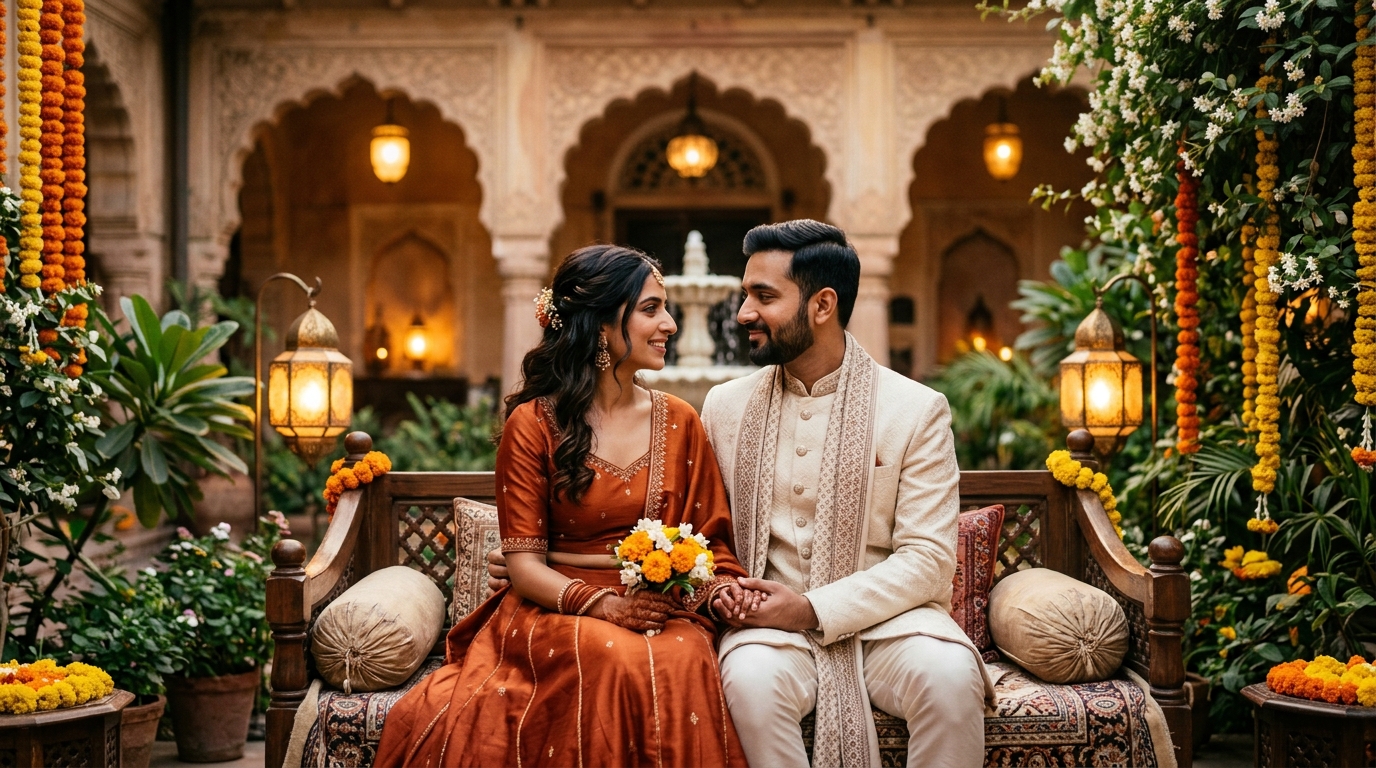
"The family opens the door; the two of you decide whether to walk through it."
What it actually is
An arranged marriage is one in which someone other than the couple — parents, an aunt who knows everyone, a temple matchmaker, a marriage bureau — takes the lead in finding and proposing a partner. Compatibility is weighed before chemistry: family, values, schooling, religion, finances, the long arithmetic of two clans becoming kin. What stays with the couple, in the genuine version of the form, is the yes. They meet, they consider, and they each retain the right to decline. The match is offered, not imposed.
This makes it a partnership built in a different order from the Western default. Where one culture says fall in love, then commit, the arranged tradition often says commit, then fall in love — trusting that affection, intimacy and even passion can be grown inside a marriage rather than required as its entry ticket.
Where it comes from
For most of recorded history, across most of the world, this is simply how marriage worked. Marriage was a contract between families — about land, lineage, alliance and survival — far too consequential to leave to the whims of the young. The romantic ideal of marrying for love, alone, because your heart insisted, is the historical newcomer, largely a Western invention of the last few centuries. Arranged marriage is the deep root; love-marriage is the recent graft.
It remains the living norm for a very large share of humanity, with especially strong traditions across South Asia, the Middle East, parts of Africa and East Asia, and within many diaspora communities worldwide. By one widely cited 2012 estimate, slightly more than half of all marriages on Earth are arranged or semi-arranged. The form many readers picture as exotic is, by sheer numbers, one of the most common shapes a marriage can take.
In Epstein, Pandit & Thakar’s 2013 cross-cultural study How Love Emerges in Arranged Marriages, self-reported love rose, on average, from 3.9 to 8.5 on a ten-point scale over the course of the marriage — the strongest predictor being commitment.
The line that matters: arranged is not forced
Everything turns on one word: consent. An arranged marriage is one the couple agrees to. A forced marriage is one entered without the free and full consent of one or both partners — secured through coercion, threats, deception, or violence — and it is a recognised human-rights abuse, never a cultural style to be respected. The Universal Declaration of Human Rights is explicit: marriage “shall be entered into only with the free and full consent of the intending spouses.” Arrangement honours that line. Force erases it.
The honest part is that the boundary can blur in practice — family pressure, duty, the weight of “everyone is waiting” can press hard on a young person’s no. A real arranged marriage protects the right to refuse and means it; the moment that right is taken away, the form has crossed into abuse and stopped being arrangement at all. Holding both truths — that the tradition is legitimate and that coercion within it is not — is the only fair way to look at it.
How it works now
Most arranged marriage today is what’s better called semi-arranged or assisted. Parents and relatives still introduce, vet and bless — but the couple dates, talks, meets repeatedly, and drives the decision. The elders curate; the candidates choose. A modern version sits comfortably between the old contract and the dating app: families shortlist, the two people fall (or don’t) for each other, and the wedding follows their agreement, not a decree.
The matchmaker, meanwhile, went digital. Matrimonial sites and apps now do at scale what an aunt once did over tea — filtering by community, profession, language, and the priorities a family cares about — so that “assisted matchmaking” and “online dating” increasingly describe the same glowing screen. The infrastructure modernised; the underlying logic, that the people who love you can help you find someone to love, did not.
The match across the gender line
One assumption survives almost every retelling of arranged marriage: that the two people are a man and a woman. The historical record is less tidy. Among the Igbo of southeastern Nigeria — and among the Nuer, Yoruba and others — anthropologists have long documented woman-to-woman marriage: a woman of standing pays the bridewealth, becomes a “female husband,” and the union secures lineage, land, and the social rights to a wife’s children. In Ifi Amadiume’s landmark study Male Daughters, Female Husbands (1987), the point is precisely that this is marriage — arranged, contractual, socially binding — without being heterosexual, and without (she is emphatic) being lesbian in the Western sexual sense. Same-sex arrangement, in other words, is neither a modern idea nor a Western one.
And the machinery adapts. In 2015 a Mumbai mother, Padma Iyer, placed what was widely called India’s first gay matrimonial advertisement — seeking a “well-placed, animal-loving, vegetarian groom” for her activist son, caste preference and gentle comedy and all. The same apparatus an aunt once worked over tea simply widened its search. What arrangement organises, underneath, was never romance between a man and a woman; it is kinship and alliance — and kinship has always been built across more configurations than the standard story admits.
Why it belongs in a modern atlas
Because it works for an enormous number of people, and the data refuse to flatter our assumptions. Studies comparing arranged and love marriages tend to find that, over the long run, the two reach broadly similar levels of satisfaction — neither order of operations holds a monopoly on happiness or on heartbreak. Love-first and commitment-first are two valid routes up the same mountain, and the view from the top can look remarkably alike.
An atlas of relationship forms that quietly assumed everyone marries the Western way would be provincial and a little condescending. Arranged and semi-arranged marriage belongs here on its own terms — as a tradition many readers were raised inside, are living now, or will choose with clear eyes: families as allies, consent as the floor, and love treated not as the price of admission but as something a marriage is built to make.
How Partnersin.love holds it
This one lives in Anchor.
Anchor is the world of the long-built bond — the partnership measured by what two people construct over years rather than by how it began. Arranged marriage’s whole wager, that commitment can grow love rather than merely follow it, is Anchor’s thesis written in an older hand.
Enter AnchorThreads to
Its closest neighbour in the Atlas is companionate marriage, which shares the bet that partnership and affection are made, not merely found; and it sits alongside monogamy as one of the world’s enduring defaults. Two Field Guides go deeper: love across difference on bridging family, culture and faith, and money and love on the material arithmetic that has always shaped who marries whom. To build a marriage on stated terms rather than inherited assumptions, the Covenant tool helps a couple author their own; the Long Together path walks the years after the vows. For the words around all of it, see the Lexicon.