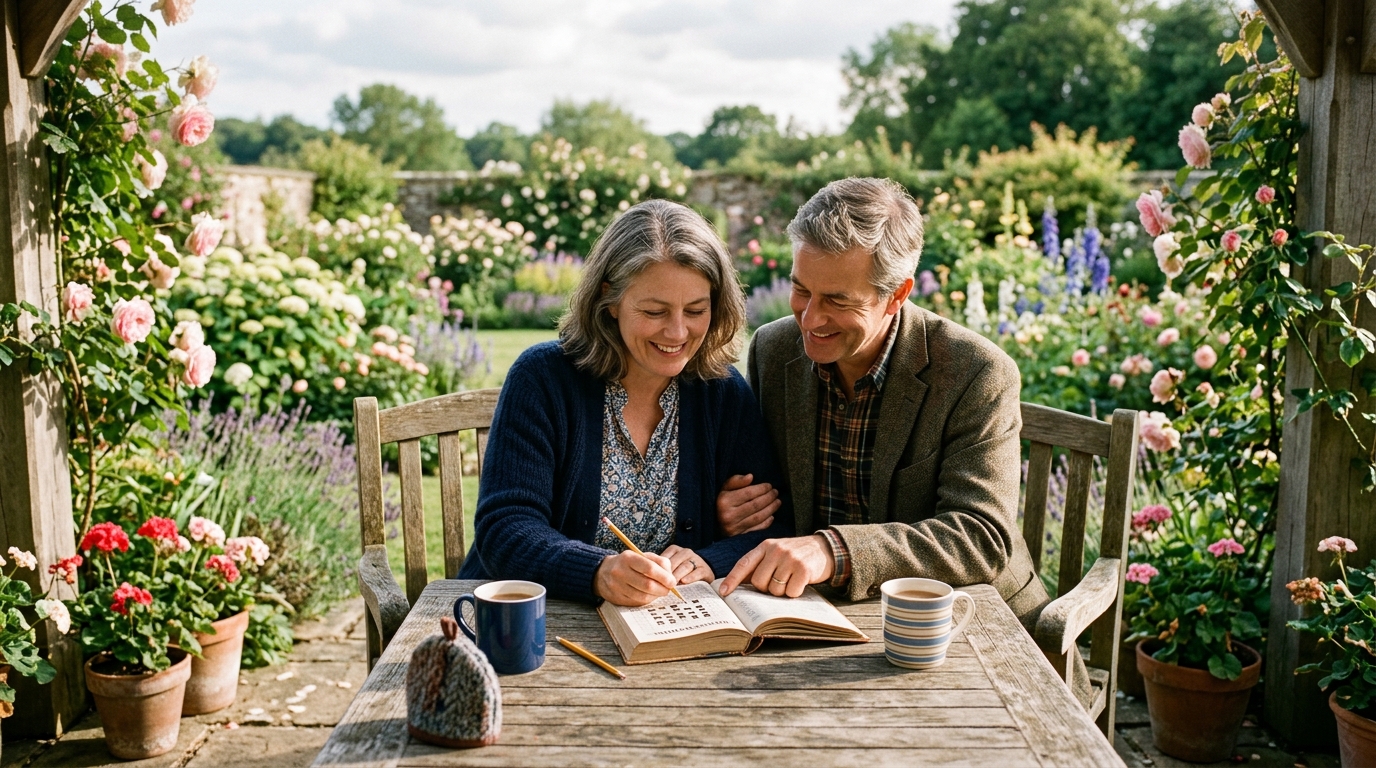
“We stopped marrying for a household and started marrying for a witness.”
What it means
A companionate marriage is one whose centre of gravity is the relationship itself — affection, friendship, mutual respect, a life designed together — rather than the economic or dynastic functions marriage used to perform. The spouses are peers. The household is run more by negotiation than by rank. And the question that decides whether the marriage is working is not are we provided for? but are we close? It is so much the water we swim in that it can be hard to see as a choice at all; for most of human history, it was not the default.
Where it comes from
For millennia, marriage was chiefly a way to organise labour, property, alliance and the raising of children — too important, as the historian Stephanie Coontz puts it, to be left to something as unstable as love. The shift came slowly through the nineteenth century, as industrialisation loosened the grip of the family farm and household economy and let couples imagine a union built on feeling. Coontz’s Marriage, a History traces how, once love moved to the centre, marriage thrived as a personal relationship even as it grew more fragile as an institution.
The phrase itself is younger. The Denver juvenile-court judge Ben Lindsey popularised “companionate marriage” in the 1920s, in a controversial book arguing for egalitarian unions with access to birth control and to divorce when love had gone. A generation later the sociologists Ernest Burgess and Harvey Locke named the whole arc in the title of their landmark 1945 text: The Family: From Institution to Companionship.
The era social scientist Eli Finkel dates as the start of the companionate marriage in America — when the job of a spouse shifted from food, shelter and protection toward love, intimacy and a fulfilling private life.
How it actually works
In practice, a companionate marriage runs on the daily mechanics of friendship: shared time, shared decisions, the steady upkeep of knowing each other. Couples therapists who study durable partnerships tend to describe the same ingredients — fondness and admiration, a rich map of each other’s inner world, the habit of turning toward one another in the small moments rather than away. Sexuality stays part of the picture, but it sits inside the friendship rather than standing in for it; desire is something the partnership tends to over time, not a fixed asset it spends down.
Equality is doing quiet work here too. When neither person is simply the provider and neither simply the dependent, almost everything — money, housework, whose career bends, how conflict gets repaired — has to be talked about rather than assumed. That is the companionate bargain: more freedom and more intimacy, bought with more conversation.
The all-or-nothing turn
The story did not stop in 1945. In Eli Finkel’s account, a third era opened around 1965: the self-expressive marriage, in which we ask a spouse not only to love us but to help us discover and become our truest selves. Finkel pictures marriage climbing Maslow’s hierarchy — from survival, to love, to self-actualisation. The catch is altitude. The higher the need we ask one relationship to meet, the more time, attention and skill it takes to meet it. So the modern marriage becomes all-or-nothing: the best partnerships are more fulfilling than the best of any earlier era, while the average one, starved of the hours those summits require, can feel thinner than marriages that once asked for less.
A common misreading
It is tempting to read companionate marriage as the moment love entered marriage, as though earlier couples felt nothing. That is not quite it. People have always loved inside marriages; what changed is that love became the point — the reason to marry, the test of whether to stay, the thing the institution is now built to serve. The risk runs the other way too: an ideal this intimate can quietly demand that one person be lover, best friend, co-parent, therapist and creative collaborator all at once. Recognising the ask is the first step toward sharing it out — across friendships, family and community — instead of asking a single bond to carry the weight alone.
Where the weight goes now
That instinct to share the load turns out to have evidence behind it. The psychologist Elaine Cheung and colleagues studied what they call emotionships — the specific people we turn to for specific feelings: one to calm us down, another to cheer us up, a third to think a problem through. Their finding is quietly subversive of the all-or-nothing ideal: people with a diverse emotional portfolio, who spread these needs across several relationships, report higher life satisfaction than those who route everything through a single person. The healthiest answer to the suffocating marriage is rarely a better spouse. It is a wider circle.
The newest answer is stranger, and not a circle of people at all. As the companionate ideal asks one partner to be lover, friend and therapist at once, tens of millions have begun offloading slices of that demand onto AI companions — apps like Replika and Character.AI, whose user counts run into the tens of millions and whose category has multiplied in only a few years. The early research is genuinely split: some studies find these chatbots ease loneliness in the short term, others warn they can deepen the isolation they soothe, or quietly exploit it. Either way it is a striking measure of the pressure Finkel named — that some people would now sooner hand the weight of “be my everything” to software than ask more humans for a little less.
Why it belongs in a modern atlas
Almost every other form in this collection is, in some sense, a response to companionate marriage — extending it, questioning it, or redistributing the load it concentrates in one relationship. To see what monogamy, anarchy and the rest are answering, it helps to name the thing they answer to. Companionate marriage is the default this atlas exists to put back into perspective: not the only shape a shared life can take, but the one most of us inherited without being asked.
How Partnersin.love holds it
This one lives in Anchor.
Anchor is the world of the long, tended partnership — fondness kept current, conflict repaired, a friendship that outlasts the first rush of passion. Companionate marriage is the ideal Anchor was built to practise, day over day.
Enter AnchorThreads to
Companionate marriage is the trunk much of this atlas branches from. Its quieter cousin is the Boston Marriage, which reached the same friendship-first union without a man or a marriage licence; the Romantic Friendship is the older intimacy it grew out of, and Monogamy is the boundary it most often assumes. If you want to feel how the ideal is built rather than declared, the Long Together path walks it, the State of Us tool gives a partnership a regular check-in, and the Lexicon keeps the vocabulary close at hand.