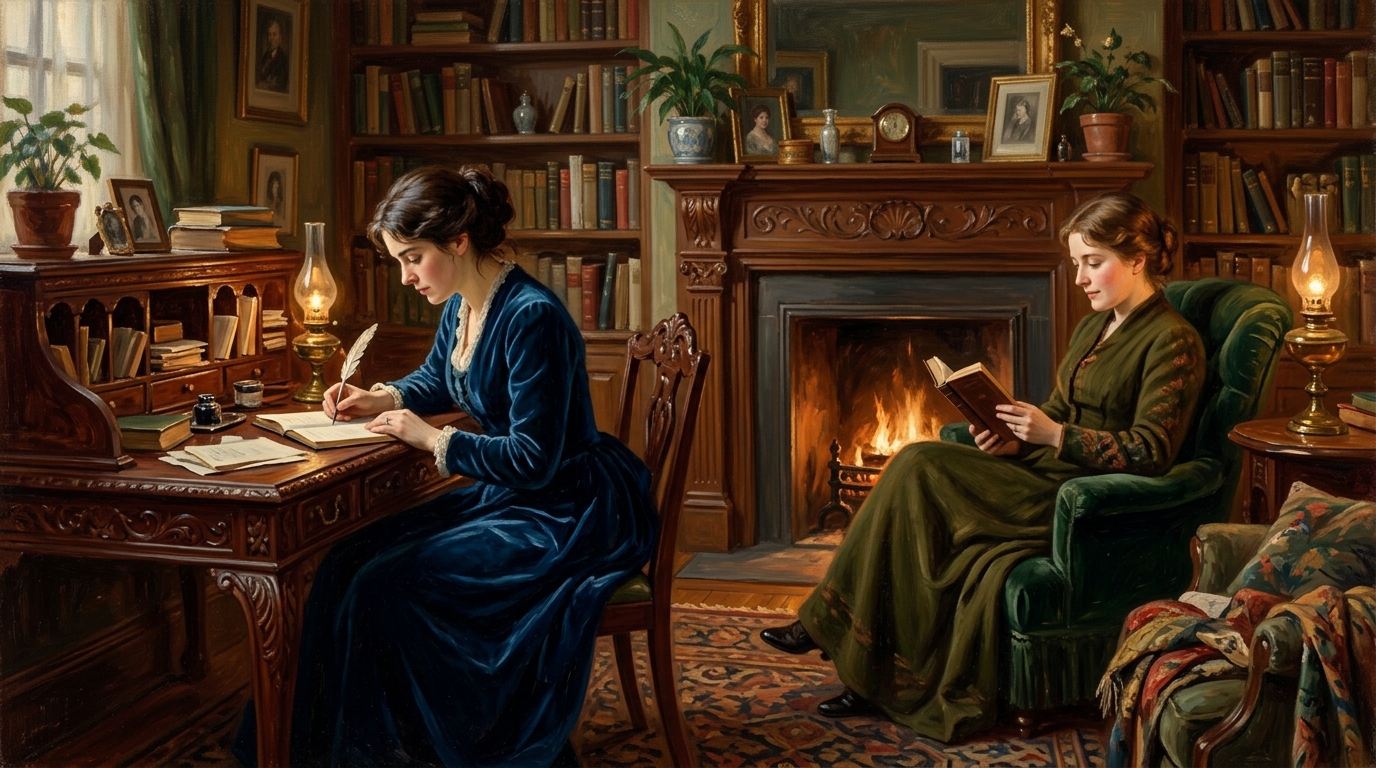
“Two forward-thinking women, a shared address, and a life nobody asked them to explain.”
Where the name comes from
The phrase is usually traced to Henry James’s 1885 novel The Bostonians, which centres on two independent women in a committed, cohabiting bond in Boston. New Englanders of the era borrowed the book’s setting as a shorthand, and the term stuck — Merriam-Webster still defines a Boston marriage as a long-term, cohabiting relationship between two women.
What it actually was
At its plainest: two women living together, financially independent of any man. Some of these partnerships were romantic and sexual; others were devoted but platonic; many sat somewhere the modern vocabulary still struggles to name. The point was the shared life — a home, a career each, a future built together — not the label on the door.
They were especially common among the first generations of college-educated American women. So many Wellesley faculty lived this way that contemporaries coined a sibling term, “Wellesley marriage.” The writer Sarah Orne Jewett and editor Annie Adams Fields are among the most cited couples of the kind.
Until roughly the 1920s, two unmarried women sharing a home were widely regarded as natural and respectable — a window of social permission that later closed.
A turn in the weather
The acceptance didn’t last. As early-20th-century sexology began to frame intimacy between women as pathology, suspicion replaced approval; by the 1920s, fewer women chose the arrangement openly, and the ones who had were retroactively read through a narrower lens. The U.S. National Park Service and the city of Boston both tie these households to the wider queer history of women’s independence and the suffrage movement — women who could vote with their living arrangements before they could vote at all.
Why it belongs in a modern atlas
Boston marriage reads as startlingly contemporary. Strip the period costume and you find ideas we’ve only recently re-named: the queerplatonic bond that refuses the romance-or-friendship binary, the chosen family, the partnership of two financially autonomous people who simply choose each other. It’s proof that none of this is new — only the words are.
How Partnersin.love holds it
This one lives in Anchor.
The quiet work of two people staying close over years — shared memory, small rituals, a partnership named by what you build, not by whom you’re expected to be. Boston marriage is Anchor’s oldest ancestor.
Enter AnchorThe form returns
The strangest thing about the Boston marriage is that it isn’t only history. A version is back, under a new name: the platonic life partnership. Friends, rather than lovers, increasingly buy homes together, co-parent, name each other as next of kin, and build the shared future the culture still reserves for romance. The drivers are partly economic — the arithmetic of two incomes against rising housing and childcare costs — and partly the loneliness epidemic; the arrangement is now common enough to carry its own news coverage and a small industry of apps for finding a co-parent or a platonic housemate.
In a way the revival is a recovery. Before early-twentieth-century sexology taught suspicion, the nineteenth century granted women a far wider bodily vocabulary of closeness — sharing beds, holding hands, writing letters of ardent tenderness — without anyone needing to file it under sexual or not. The historian Carroll Smith-Rosenberg showed that this “female world of love and ritual” was ordinary and respectable rather than hidden. What the Boston marriage had, and what the platonic life partnership is reaching for again, is permission to let a shared life be central — and physically affectionate — without first answering the question the modern world insists on asking: but are you actually together?