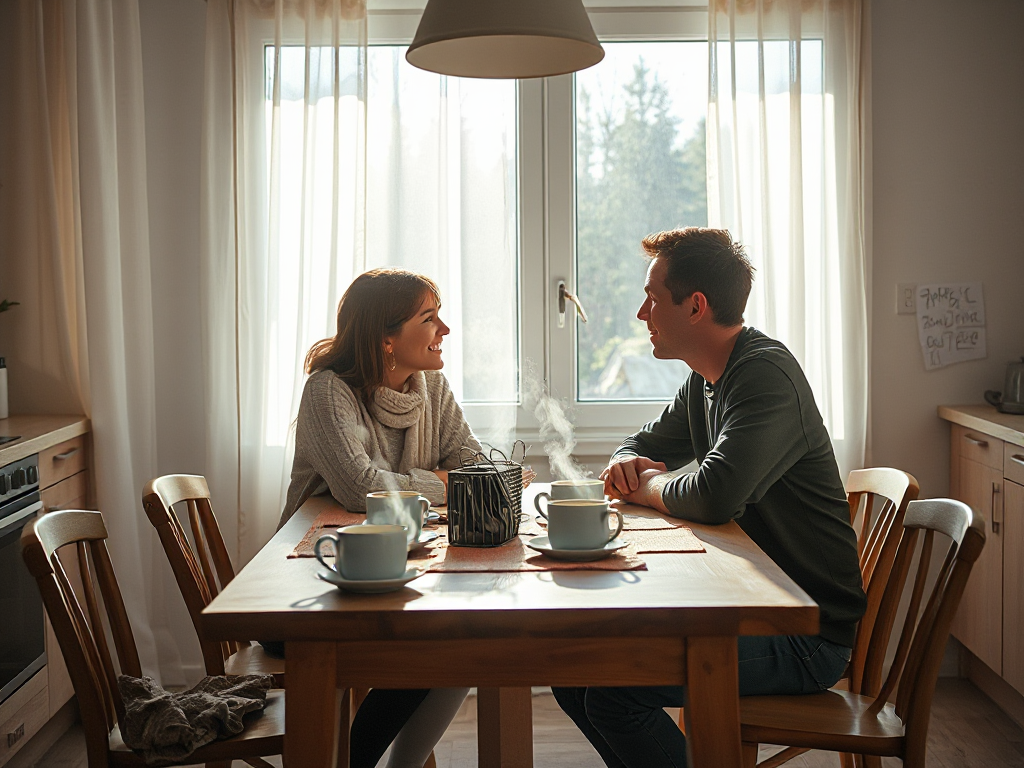
"The door isn't left open by accident. Two people agree, out loud, to keep it unlocked."
What it is
An open relationship is, in its plainest definition, an intimate partnership that is non-exclusive by agreement. Wikipedia frames it as a relationship that is sexually or romantically open while keeping a primary emotional bond between the two partners at its centre. The decisive word is agreement: what separates this from an affair is not the second person but the first conversation — the one where both people say yes, with their eyes open, before anything begins.
It sits under the umbrella of ethical non-monogamy, and it is usefully distinguished from its neighbours. Where polyamory tends toward multiple loving, emotionally serious bonds, an open relationship usually keeps one couple at the core and treats outside connections as more sexual than romantic. And where swinging is often a shared, recreational activity a couple does together, an open relationship more commonly grants each partner the freedom to step out on their own.
Where the name comes from
The phrase entered the language sideways. In 1972 the anthropologists Nena and George O’Neill published Open Marriage: A New Life Style for Couples — a book that spent some forty weeks on the New York Times bestseller list and was translated into more than a dozen languages. Its argument was mostly about not non-monogamy: it pleaded for trust, equality, separate friendships and room to grow as individuals rather than collapsing two people into one closed unit. Only a single chapter, “Love Without Jealousy,” floated the possibility of sex outside the marriage.
But that chapter was the one the culture remembered. Through talk shows and magazine spreads, “open marriage” hardened into a synonym for a sexually non-exclusive one — to the authors’ visible regret; by 1977 Nena O’Neill was writing in defence of fidelity. The misreading, however, gave the modern arrangement its name, and Merriam-Webster now records “open marriage” in exactly the sense the O’Neills never quite intended.
How it actually works
In practice an open relationship is less a free-for-all than a small, living constitution. Couples negotiate the terms that matter to them: who is fair game and who is off-limits, whether outside partners are met once or seen again, what counts as too much closeness, what gets disclosed and what stays private, and whether sex elsewhere is welcome but a second love is not. These rules are not carved once and forgotten — they are revisited, renegotiated, and sometimes torn up as the people change.
The load-bearing skill is not adventurousness but honesty. Open couples lean on explicit consent, regular check-ins, and a shared appetite for the conversation most partnerships avoid. The reward many describe is not merely variety but a particular clarity: when nothing is assumed, everything has to be chosen — including, every day, each other.
Across two national U.S. samples of single adults (Haupert et al., 2017), roughly 21% reported having engaged in some form of consensual non-monogamy at least once in their lives — a figure that held steady across age, income, religion and politics.
A common misreading
The persistent misconception is that opening a relationship is what people do when the love is failing — a polite word for the exit. Sometimes, of course, it is. But researchers who study consensual non-monogamy repeatedly find that people in openly negotiated arrangements report satisfaction, trust and commitment broadly comparable to those in exclusive ones; the structure itself is not the symptom. An open relationship is not the absence of a boundary. It is a differently drawn one — and like any boundary, it holds only as well as the agreement and the candour behind it.
An old freedom, newly shared
Non-exclusive marriage is ancient — but for almost all of that history it ran one direction. Across cultures a husband’s sexuality outside the marriage was institutionalised and tolerated, through concubinage, the kept mistress, or plural marriage open only to men; a wife’s equivalent was named adultery and punished, sometimes by death. Openness, in other words, is old — but it was a male privilege wearing the costume of custom. The genuinely modern thing about the open relationship is not the open door. It is that both people now hold a key.
That symmetry is the real achievement, and also the hardest part, because an equal rule does not erase an unequal inheritance. An agreement can be written perfectly balanced and still meet a world that has spent millennia teaching men and women to feel differently about the same freedom — who is entitled to want it, who is judged for using it, whose outside interest reads as vitality and whose as betrayal. A couple opening up today is not only drawing their own boundary; they are renegotiating, in private, a double standard far older than either of them. The honest version of this entry’s optimism is that the symmetric open relationship is a real moral advance and an unfinished one — easy to write into an agreement, much harder to feel all the way down.
Why it belongs in a modern atlas
For many people, openness is the first door out of the assumption that one partner must be everything — every lover, every confidant, every future. It keeps the centre that monogamy prizes while loosening the rule that the centre must be the whole. As a threshold form, it is where a great deal of modern non-monogamy actually begins: not as a manifesto, but as two people, already committed, deciding to talk about what else might be possible.
How Partnersin.love holds it
This one lives in Orbit.
A strong centre and other bodies in motion around it — held by agreement, not by accident. Orbit is for couples opening the door on their own terms and wanting the conversation to be clean.
Enter OrbitThreads to
If the door opens only a crack, you arrive at monogamish — mostly closed, with named exceptions. Open wider toward shared adventure and it shades into swinging; open wider toward second loves and it becomes polyamory. Whichever way the hinge turns, the first move is the same: draw the boundary together with Consent Keyrings, walk the Opening the Door path, and look up any word you meet in the Lexicon.